
Osteoarthritis relief and management methods

Osteoarthritis: Causes, Symptoms, and Pain Relief
What are the signs and symptoms of osteoarthritis? Osteoarthritis symptoms vary from person to person.4 Not everyone experiences pain and disability from osteoarthritis. For some, it causes only mild symptoms that come and go – but for others, it can be a constant source of pain with debilitating symptoms.
Signs and symptoms of osteoarthritis include:
Joint pain - Sore, achy joints can be a result of friction and inflammation in the affected joint.
Morning stiffness - Pain and stiffness when you first wake up in the morning may be attributed to osteoarthritis. It often improves after activity.
Joint inflammation that tends to get worse later in the day - As your affected joints are used throughout the day, day-to-day activities can result in increased inflammation at the end of the day.
Joint pain or stiffness after repetitive use - Your joints may hurt during or after activity, especially actions that repeat themselves, like typing or hammering.
Swelling of joints - Increased fluid in the joint as well as soft tissue inflammation may result in joint swelling.
Decreased range of motion - As the affected joint swells, flexibility and range of motion in the joint may decrease.
Clicking or cracking sound when a joint bends - A crunching sound that you feel or hear when using your joints can indicate bone-on-bone friction. You might hear popping or cracking when you move your joint.
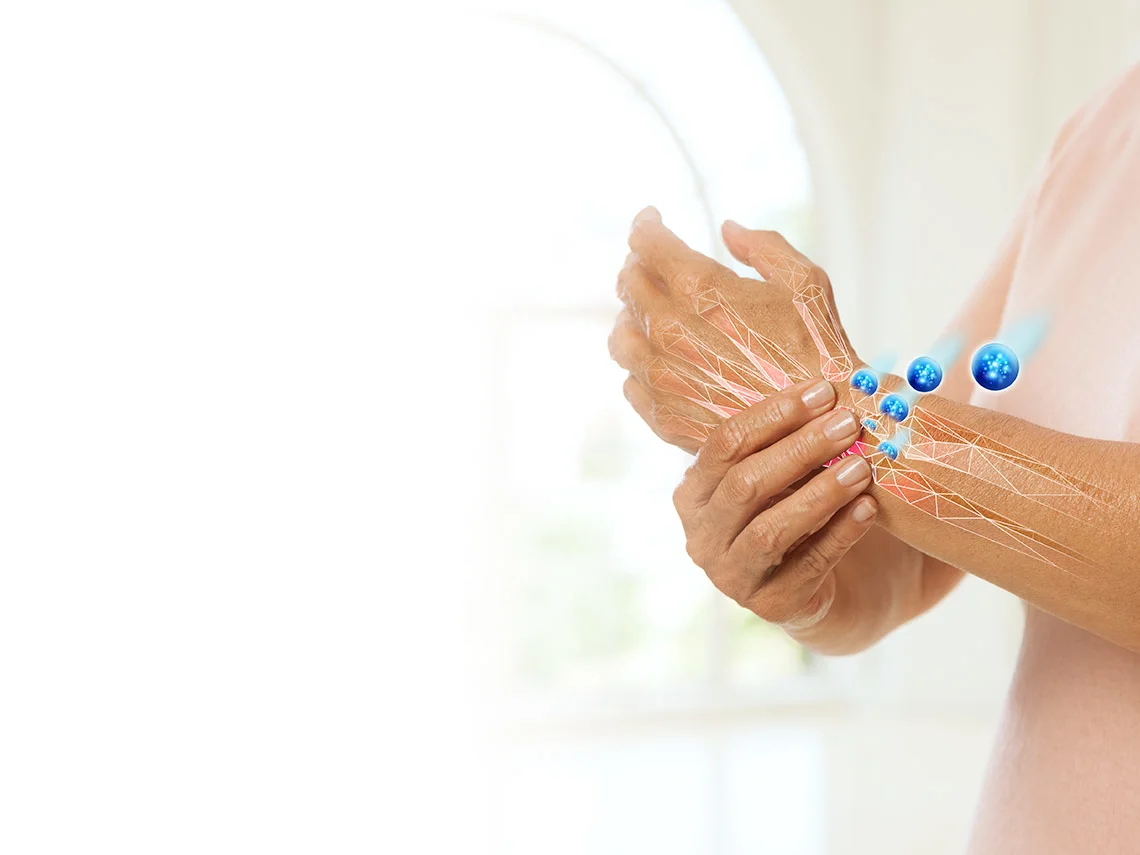
Osteoarthritis can affect any joint. However, it is most likely to affect the hips, knees, neck, lower back or small joints of the hands.5
Cartilage, which acts a little bit like your body’s shock absorbers by cushioning between bones that meet up at a joint, is worn down from bearing weight over the course of many years. Kind of like tires on a car that get worn down the more kilometres you put on the car. Hopefully, you’ve seen some really good places along the way!
Osteoarthritis can be caused by:
Extra weight
Carrying around excess bodyweight can place increased strain on your joints, leading them to deteriorate quicker than if you were at an ideal BMI.6Repetitive use
Using the same joints over and over again – whether at a job, sport, or hobby - puts stress on the joint, which can cause the cartilage to deteriorate.Injury
A previous injury such as a break or tear near the joint can lead to osteoarthritis years later.
Osteoarthritis risk factors include:7,8,9
Genetics - Some types of arthritis can be genetic, so if your parents or siblings have the condition, you may be at a higher risk of developing it too.
Age - The older you get, the higher the probability of developing osteoarthritis. On the flipside, younger people who experience joint pain, swelling or stiffness might dismiss or not even consider the possibility of having osteoarthritis, however, unfortunately you can get osteoarthritis in any stage of life - even young adulthood. Even though it can occur in young adults, it’s most common in those age 65 and up.
Gender - Women are more likely than men to develop certain types of arthritis, including osteoarthritis.
Previous injury - If you have ever injured a joint badly enough, you could develop osteoarthritis in that area later in life.
Obesity - Excess weight puts stress on joints and can put you at a higher risk of developing osteoarthritis.
Your job - If your work puts a lot of repetitive stress on a particular joint, for example if you have to use your hands all day typing or cutting hair, you are more likely to develop osteoarthritis due to overuse of that joint.
For mild aches and pains associated with osteoarthritis, a simple talk with your healthcare professional may do the trick. If you think you may have severe osteoarthritis or if your pain is becoming more persistent, you may want to make an appointment with your doctor.
Your doctor can diagnose osteoarthritis after examining the affected joint or joints to check the range of motion or freedom of motion, plus to see if there’s swelling or tenderness10. Your doctor or pharmacist can advise you on medicines, exercises, and other methods that can be used to help relieve the pain associated with osteoarthritis and start the journey back to moving with joy again.
Managing pain and restoring joint function is the name of the game when it comes to effective osteoarthritis pain relief. Here are some helpful resources in managing osteoarthritis pain:
1 Hirsh MJ, Lozada CJ. Medical management of osteoarthritis. Hospital Physician 2002; 57–66. WebMD (2018). 5 common types of arthritis. Available at: http://www.webmd.com/rheumatoid-arthritis/guide/most-common-arthritis-types?page=2 http://www.webmd.com/rheumatoid-arthritis/guide/most-common-arthritis-types?page=2 (accessed 20th May 2020)
3 Centers for Disease Control and Prevention. Web. https://www.cdc.gov/arthritis/basics/risk-factors.htm https://www.cdc.gov/arthritis/basics/risk-factors.htm
4 Centers for Disease Control and Prevention. Web. https://www.cdc.gov/arthritis/basics/risk-factors.htm https://www.cdc.gov/arthritis/basics/risk-factors.htm
5 Arthritis Foundation. Web. https://www.arthritis.org/health-wellness/about-arthritis/understanding-arthritis/recognizing-the-symptoms-of-arthritis https://www.arthritis.org/health-wellness/about-arthritis/understanding-arthritis/recognizing-the-symptoms-of-arthritis
6 Bliddal H, Leeds AR, Christensen R. Osteoarthritis, obesity and weight loss: evidence, hypotheses and horizons – a scoping review. Obes Rev 2014;15(7):578–586.
7 NICE: National Collaborating Centre for Chronic Conditions. Osteoarthritis: national clinical guideline for care and management in adults. London: Royal College of Physicians, 2014
8 Kenny T (2014) Osteoarthritis. Available at: http://www.patient.co.uk/health/osteoarthritis-leaflet http://www.patient.co.uk/health/osteoarthritis-leaflet (accessed March 2016)
9 Arden N, Nevitt M. Osteoarthritis: epidemiology. Best Pract Res Clin Rheumatol 2006; 20(1):3–25 10 NICE: National Collaborating Centre for Chronic Conditions. Osteoarthritis: national clinical guideline for care and management in adults. London: Royal College of Physicians, 2014


Pain is rarely just physical nor is it always solved by taking medicine alone. Voltaren is your ally in helping you take more control of your pain journey, from the way to sleep, to what you eat, mental wellbeing and complementary pain relief therapies.